
Project ServicesScheduler
Objects
Overview
Users can use this page mainly to view which Schedules include the selected virtual machine. It is also possible to create a new schedule by clicking the “+ Add Schedule” button, which redirects to the Create schedule page.
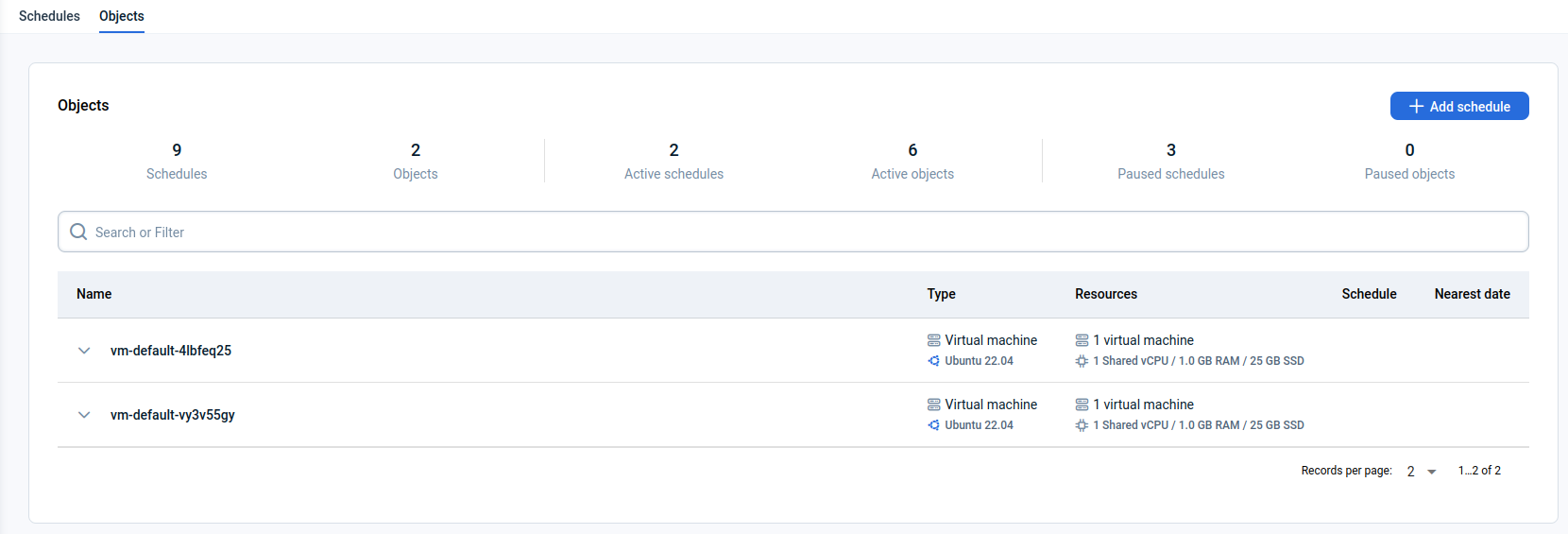
Page description
Information pane:
- Schedules: total count of schedules in the project.
- Objects: total count of objects across all schedules.
- Active schedules: number of schedules with the "Nearest date" set in the future.
- Active objects: number of objects scheduled for the "Nearest date" in the future.
- Paused Schedules: count of schedules currently paused.
- Paused Objects: count of objects within paused schedules.

Key Features and Functions by default:
- “+ Add Schedule” button: create a Schedule on the Create schedule page.
- Search line: if you know the virtual machine name and need to find it, start typing its first letters.
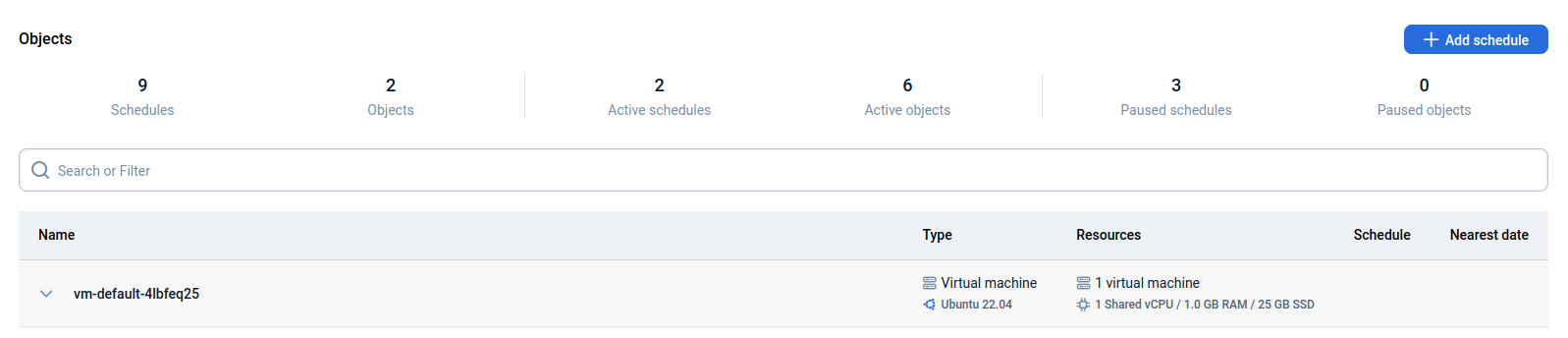
- Name: the name of a virtual machine.
- Type: information about the object type and operating system.
- Resources: resource details for the selected virtual machine, such as the number of vCPUs, amount of RAM, and SSD size.
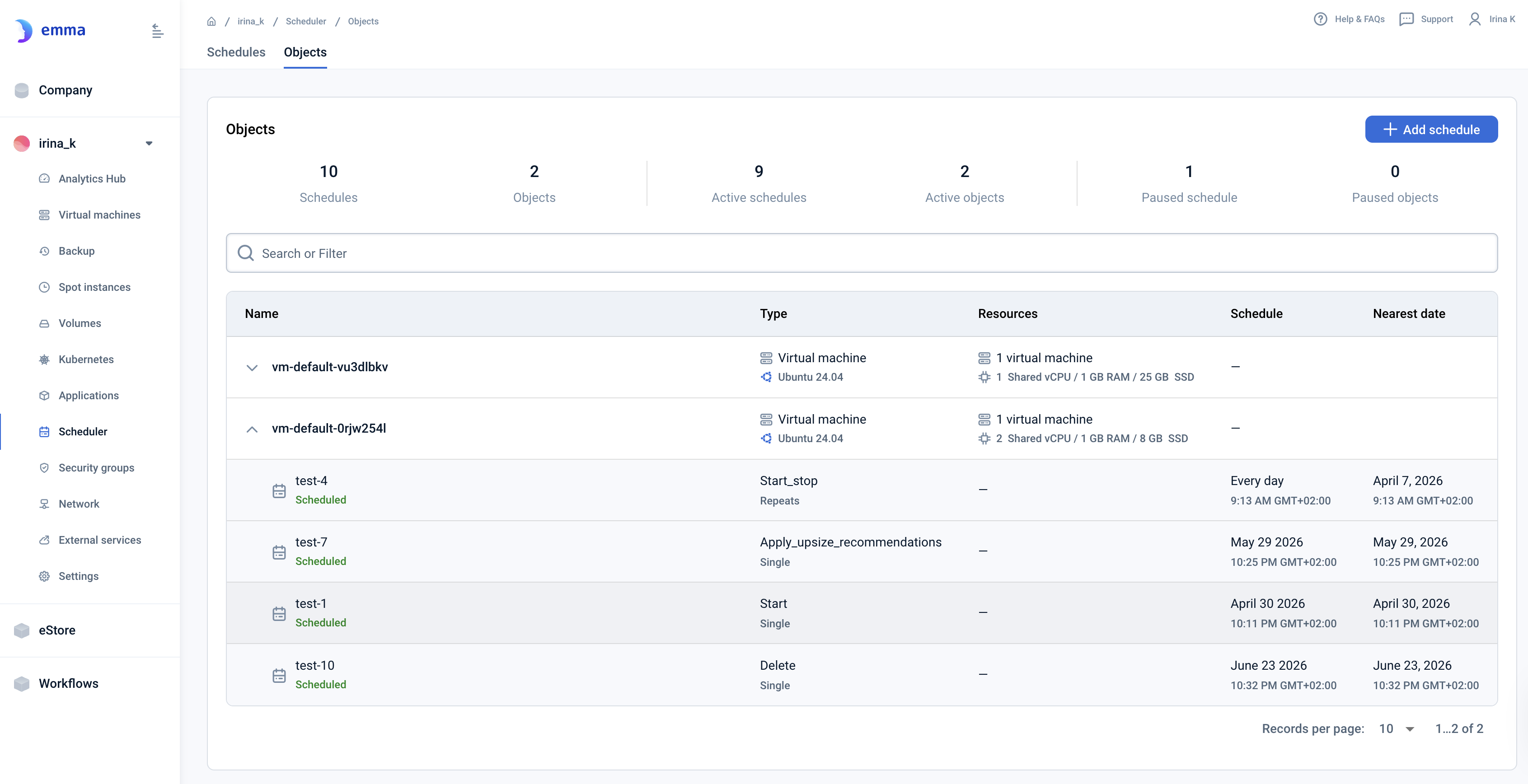
Key Features and Functions available upon selecting the virtual machine line:
- Name: schedule name with status. Detailed information about statuses can be found in the FAQ.
- Type: information about the action type included in the schedule.
- Action: shows the action configured for the schedule. Detailed information about actions can be found in the FAQ.
- Schedule: action launch schedule.
- Nearest date: the next date and time when the schedule will run.
FAQ
What do schedule statuses signify?
- Scheduled: the schedule is active, and actions will commence as scheduled.
- Paused: the schedule is halted, and actions will not be initiated.
- In progress: actions on scheduled resources are currently underway.
- Error: an error has occurred.
What actions can I perform with scheduled resources?
- Start: power on virtual machines according to a schedule. For example, to start a virtual machine daily at 9 a.m.
- Shutdown: power off virtual machines according to a schedule. For example, to shut down a virtual machine daily at 5 p.m.
- Reboot: restart virtual machines according to a schedule. For example, to reboot a virtual machine every Friday at 11 a.m.
- Start/Stop: power on and power off virtual machines according to a schedule. For example, to start a virtual machine daily at 9 a.m. and shut it down daily at 6 p.m.
- Apply rightsize recommendations: apply advisor recommendations that reduce a virtual machine’s configuration to better match actual workload and lower costs. This action is typically used when CPU or memory utilization remains low over time.
- Apply upsize recommendations: apply advisor recommendations that increase a virtual machine’s configuration to ensure sufficient performance under sustained high load. This action is typically used when CPU or memory utilization remains high over time.
- Apply delete recommendations: apply advisor recommendations that delete idle virtual machines to eliminate unnecessary costs.
- Apply reallocate recommendations: apply advisor recommendations that move resources to a lower-cost location. Depending on the recommendation, this action can reallocate a virtual machine to another data center, move it to another provider, or reallocate a volume.
- Clone: create an identical copy of an existing virtual machine. For example, to clone a virtual machine every 5th day of the month at 10 p.m.
- Delete: delete virtual machines according to a schedule. For example, to delete virtual machines on the last day of each month at 8 p.m.
What actions can I take depending on my project role?
- Users with “Manage” infrastructure permissions in the project can perform any actions with any Schedules.
- Users with “Operate” infrastructure permissions in the project can perform any actions with Schedules for Start, Shutdown, Reboot, and Start/Stop.
- Users with “Read” infrastructure permissions in the project can only see a list of Schedules and their detailed information, but can not perform any actions with any Schedules.
How is this guide?
Last updated on 1 Aug 2026