
Manage user permissions
Overview
Project owners or company admins can use this page to view, add, edit and delete permission sets. These sets of permissions can then be assigned to users which gives them varying levels of access to core parts of your company.
What are the core parts of the company controlled by a permission set? - FAQ
-
Company settings
What is a permission set? - FAQ
Four categories of permissions or accesses are bundled together to form a permission set. These four categories of permissions pertain to necessary access to all disparate core parts of the company. Each of these four categories of permission has 3-5 levels of permission. Each of these permission levels is in incrementally increasing order to each other. The permission categories and their respective permission levels in incrementally increasing order are as follows:
-
Company infrastructure Manage list of own SSH keys - Users are allowed to manage the list of added SSH keys. Read infrastructure - Users are allowed to read the list of company SSH keys, Multi-cloud network, External integrations, External services. Manage list of company SSH keys - Users are allowed to manage the list of company SSH keys. Operate infrastructure - Users are allowed to operate External services. Manage infrastructure - Users are allowed to manage Multi-cloud network, External integrations.
-
General Read company info - Users are allowed to read company information. Read billing information - Users are allowed to read company billing information. Edit payment methods - Users are allowed to manage company payment methods.
-
Projects Read own projects and project groups - Users are allowed to read list of their created projects and parent project groups, including the number of projects associated with these groups. Read company projects and project groups - Users are allowed to read list of projects and parent project groups. Manage project user lists - Users are allowed to manage the list of project users. Manage projects and project groups - Users are allowed to create, manage and delete all projects and parent project groups.
-
Users Manage your profile - Users are allowed to edit their profile. Read the list of company users - Users are allowed to read the list of users. Manage list of company users - Users are allowed to manage the list of users. Manage project roles - Users are allowed to manage project roles. Manage permission sets - Users are allowed to manage permission sets.
Is a permission set the same as a project role? - FAQ
The screenshot displays four permission categories in the second through fifth columns, with each permission set named in the “Permission set” column. These permission sets are distinct from project roles, which are also present on the previous parent company user settings page and define various types of project-related access.
The permissions below are set at the company and user levels, not at the project level.
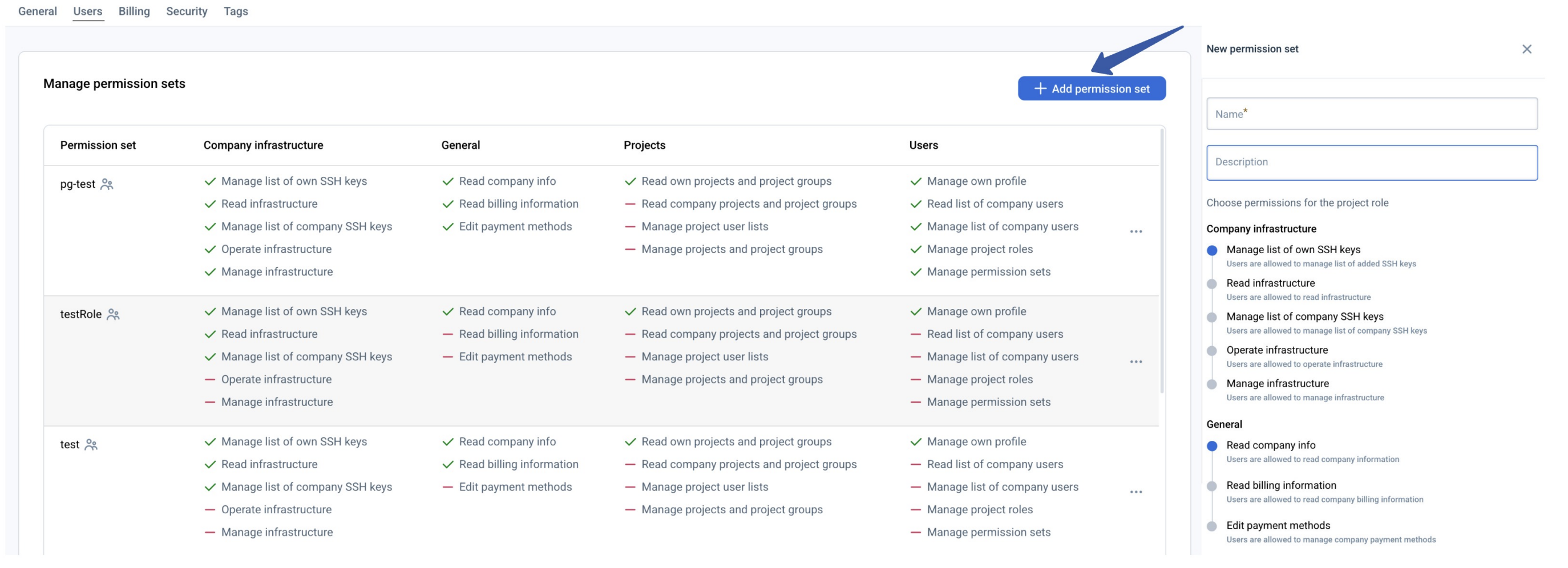
Table report on this page
This table displays the list of different permission sets already defined in your company. The table also elaborates on the constituent permission levels in each of the permission categories.
Actions you can perform on this page
You can add a custom permission set using this page. If you click on the + ADD PERMISSION SET button, a sidebar will open up on the right.
You can add your custom permission set using this sidebar. You can use this custom permission set to assign company-level core accesses to users. Add a name for the permission set and a meaningful description. After that, you need to select a permission level in each of the permission categories. The first permission level is selected by default, in each permission category, and it lets user just manage their profile/environment and has access to basic company info.
Last updated on 1 Aug 2026